
Natural and Visual Perspective examines Natural Perspective and Visual Perspective Type 2: the geometrical, optical, retinal and perceptual processes through which spatial reality is seen and experienced.
Following the sequence from space, light and viewpoint through optical projection, retinal image formation and perceived visual space, the book explains how size, shape, colour, atmosphere, occlusion, resolution and movement transform appearance. Three central chapters use original ray diagrams to examine monocular and binocular vision, vergence, disparity, stereopsis and the visual generation of depth.
Through Perspective Category Theory, the book connects Natural Perspective, Optical Perspective and Visual Perspective Type 2, while developing concepts including natural scaling, visual lateral distortion, the Sphere of Vision, geometrical and optical vanishing structures and the scale–shape/size problem.
Volume 3
FORTHCOMING FIRST EDITION
Natural and Visual Perspective
A new account of how spatial reality gives rise to natural appearance—and how natural appearance becomes human visual experience.
Expected Price: US$27.99
Large-format 8.5 × 11-inch paperback
Approximately 350 pages, printed on white paper

About This Volume
As the third volume of The Art and Science of Perspective, Natural and Visual Perspective develops the theoretical foundations introduced in Volume 1 and defined in the Dictionary of Perspective into a sustained examination of natural appearance and human visual experience.
Bringing together geometry, optics, visual perception and representational theory, it is intended for artists, architects, designers, photographers, filmmakers, scientists, engineers, researchers, students and digital creators.
What Makes Natural and Visual Perspective Distinctive
- A detailed study of Natural Perspective and Visual Perspective Type 2
- A continuous account of the progression from physical space and illumination to retinal imagery and perceived visual space
- Original theoretical diagrams explaining monocular and binocular vision, retinal image formation and the visual field
- Analysis of size, shape, scale, colour, atmosphere, occlusion, resolution and movement
- Detailed treatment of vergence, binocular disparity, stereopsis and the visual generation of depth
- New and refined concepts including natural scaling, visual lateral distortion and the Sphere of Vision
- Examination of geometrical and optical vanishing structures and the scale–shape/size problem
- Integration of natural, optical and visual processes through Perspective Category Theory
It draws on the wider research resources of the Perspective Research Centre, including the Bibliography of Perspective, the Library of Perspective, and the Encyclopedia of Perspective.
Inside the Book
Natural and Visual Perspective contains original diagrams examining the geometrical, optical and perceptual processes through which spatial reality becomes visual experience.

Selected diagrams showing projection, image formation, reflection and visual rays.
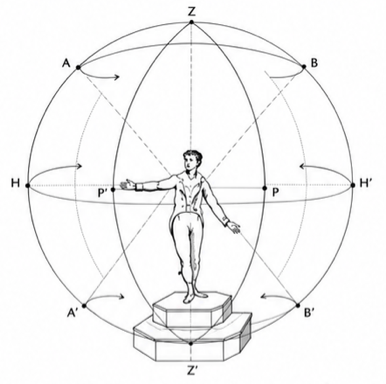
Observer-centred visual space represented as a spherical field.
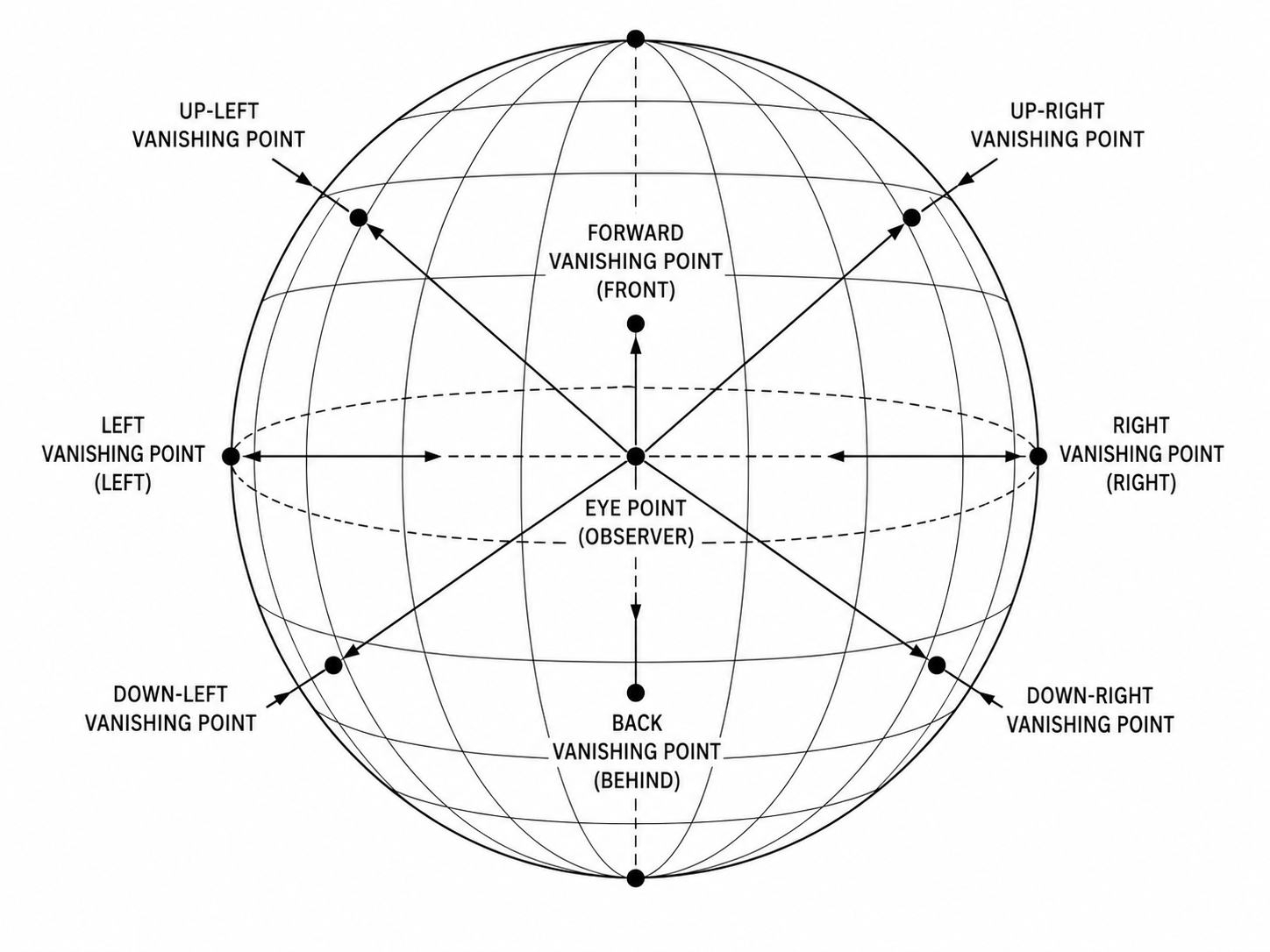
Directional vanishing points organised around the observer within a spherical field.
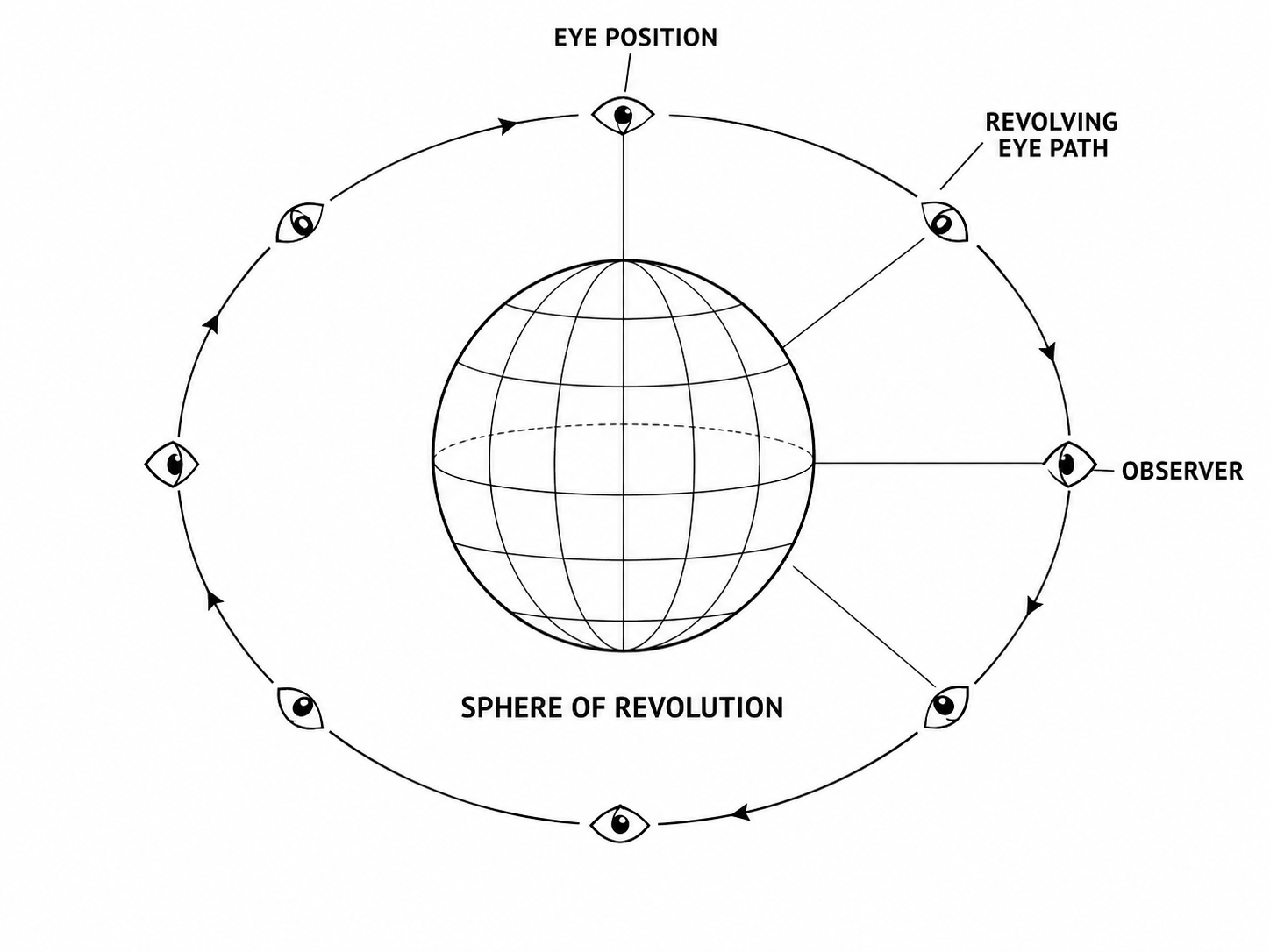
An eye revolving around an object-centred sphere and viewing it from successive positions.
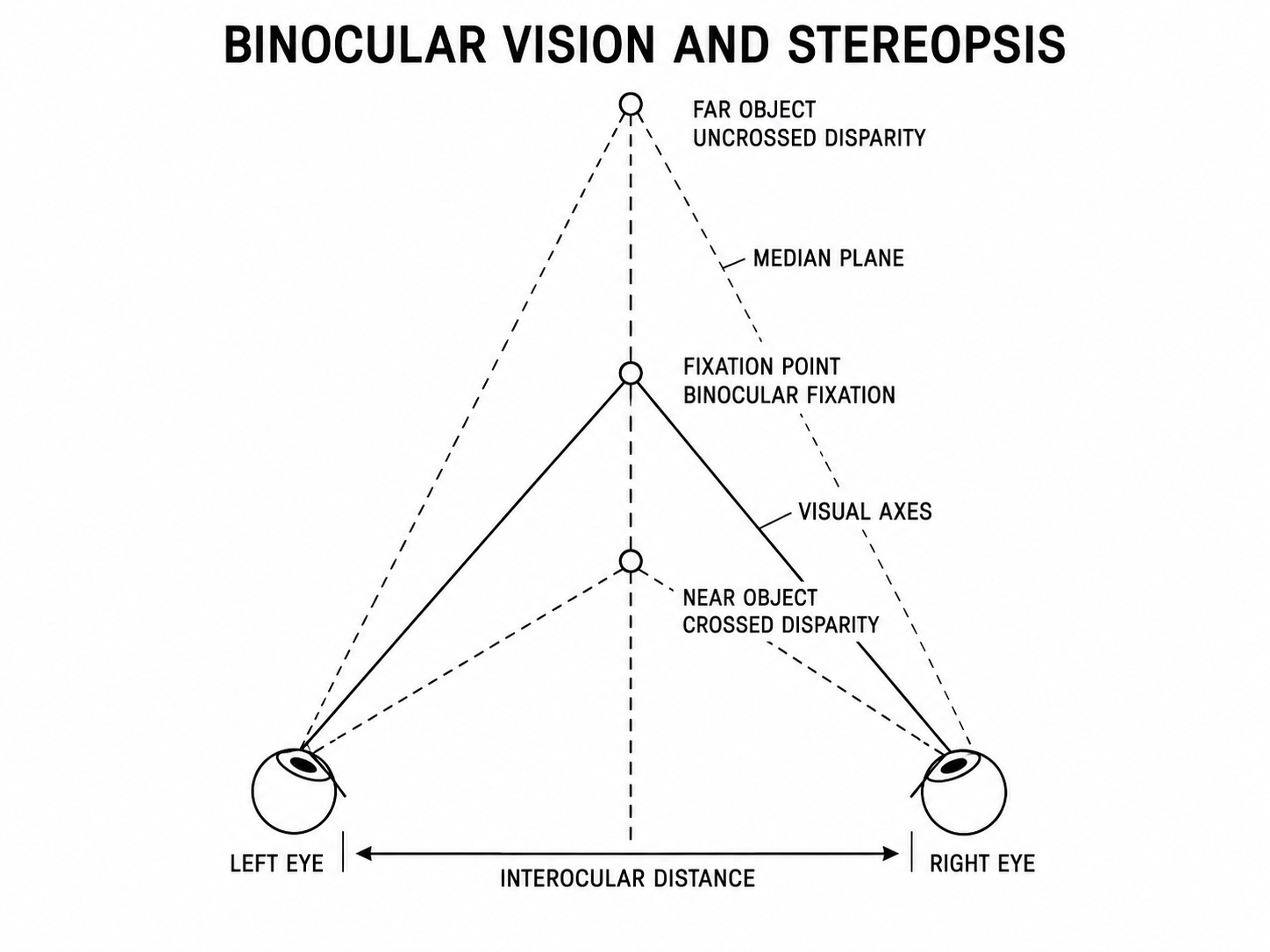
Visual axes, fixation, disparity and the binocular generation of depth.
Perspective Category Theory
The book uses Perspective Category Theory to distinguish and connect Natural Perspective, Optical Perspective and Visual Perspective Type 2.
Rather than treating physical appearance, optical image formation and visual perception as isolated subjects, it follows the complete chain from natural space and illumination, through viewpoint and optical projection, to retinal formation and perceived visual space.
This framework makes it possible to identify where different perspective processes occur, how one process becomes the input to another, and how physical, optical, physiological and perceptual transformations combine in human vision.
What the Book Covers
The principal subjects include:
- natural space, light, illumination and viewpoint;
- natural appearance and visual rays;
- Natural Perspective, Optical Perspective and Visual Perspective Type 2;
- the optical and image-forming functions of the eye;
- retinal image formation and retinal projection;
- the visual field and the Sphere of Vision;
- monocular vision and monocular depth information;
- binocular vision, vergence and corresponding retinal locations;
- binocular disparity, stereopsis and the visual generation of depth;
- apparent size, shape, scale and distance;
- colour, atmosphere, resolution and visibility;
- occlusion, motion and changing viewpoint;
- natural scaling and visual lateral distortion;
- geometrical and optical vanishing structures;
- the Vanishing Sphere and Sphere of Revolution;
- the scale–shape/size problem;
- relationships between natural, optical, retinal and perceptual space;
- Perspective Category Theory and the chaining of perspective processes;
- applications to art, architecture, photography, cinema, CGI, virtual reality and visualisation.
The First Three Volumes
The first three volumes of The Art and Science of Perspective provide complementary approaches to the field:
Volume 1 — The Past, Present and Future of Visual and Optical Perspective
A wide-ranging introduction to the history, theory, applications and future possibilities of perspective.
Volume 2 — Dictionary of Perspective
A comprehensive specialist dictionary and taxonomy containing more than 4,000 terms and approximately 1,200 perspective types and forms.
Volume 3 — Natural and Visual Perspective
A detailed investigation of how physical space becomes natural appearance and how natural appearance becomes human visual experience.
Together, the three books provide a foundational reference for understanding visual and optical perspective across art, geometry, optics, architecture, photography, imaging and visual perception.
Related Perspective Topics
Science of Perspective →
Perspective Theory →
Perspective Category Theory →
Natural Perspective →
Visual Perspective →
Optical Perspective →
You must be logged in to post a comment.