
Two-point perspective images are linear-perspective images in which two principal families of parallel spatial lines recede towards separate vanishing points. In the familiar level configuration, these two vanishing points lie on the horizon line while vertical directions remain parallel in the image.
This visual collection presents representative two-point perspective images across drawing, architecture, interiors, streets, photography and computer graphics. It also shows how viewpoint, vanishing-point separation and picture-plane relationship can substantially alter the appearance of the same basic geometrical system.
Two-point perspective images
Explore representative examples below. Each image illustrates a particular appearance, application or geometrical feature of two-point perspective.
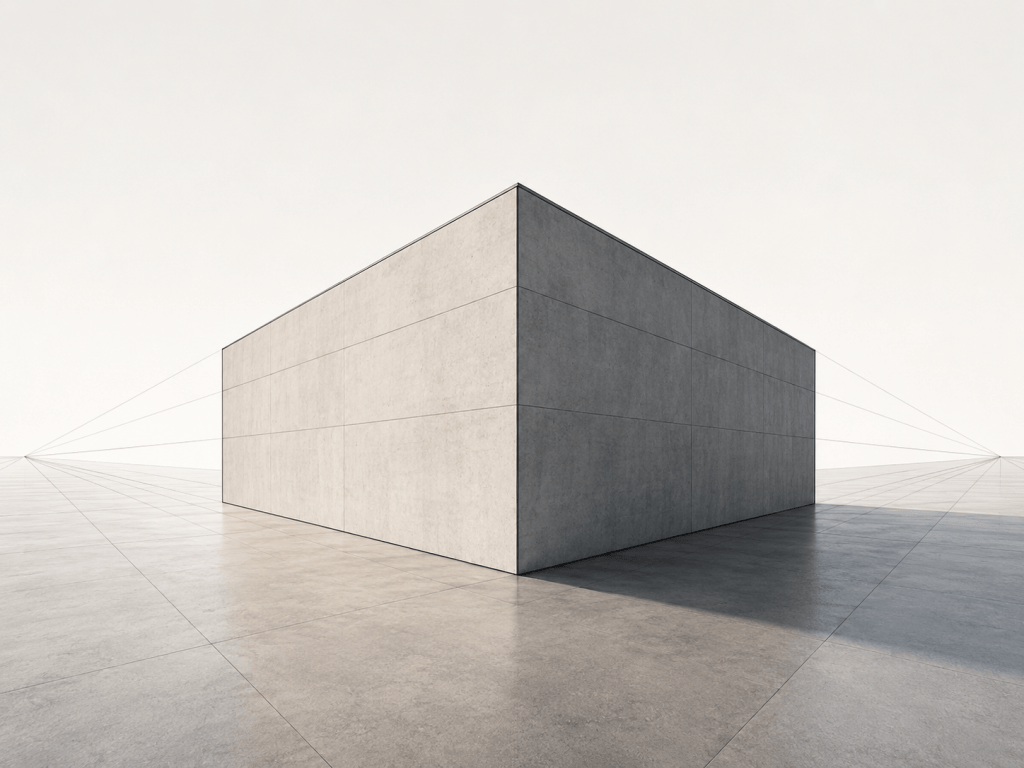
Basic Two-Point Construction
A rectilinear object turned obliquely to the picture plane produces two principal receding directions. Each family of parallel horizontal edges converges towards its own corresponding vanishing point.

Buildings & Architectural Corners
Buildings provide especially clear two-point images because their horizontal edges often form two dominant orthogonal line systems. When a corner faces the viewer, those systems recede towards opposite sides of the image.

Streets & Urban Views
Street corners, blocks and urban intersections often reveal two strong horizontal directional systems. Receding façades, roof lines, kerbs and paving edges may converge towards separate vanishing points on the horizon.

Interior Two-Point Perspective
An interior viewed diagonally rather than frontally can reveal two sets of receding walls, floor edges, ceiling lines and furnishings. These establish a two-point directional structure rather than the more familiar central one-point arrangement.

Vanishing-Point Separation
The apparent strength of convergence depends strongly upon the angular relationship of the spatial directions to the picture plane. Widely separated vanishing points generally produce gentler convergence, while closer vanishing points create stronger angular effects.

Off-Centre & Asymmetrical Views
Two-point perspective does not require the object, nearest corner or vanishing points to be symmetrically positioned within the frame. The image may be strongly asymmetrical while retaining the same underlying directional geometry.

Photography
Photographs frequently display two-point perspective when a camera views a rectilinear subject obliquely. Buildings, furniture, streets and architectural interiors commonly produce two dominant horizontal vanishing directions.

Computer Graphics
Virtual cameras can reproduce two-point perspective mathematically when two principal horizontal scene directions recede obliquely from the camera. The same structure appears in CGI, games, simulation and architectural visualisation.
What two-point perspective images show
In the conventional two-point arrangement, two principal families of parallel spatial lines recede towards two finite vanishing points. These directions are commonly horizontal and mutually perpendicular in object space, as in the edges of a rectangular box, building or room.
When the vertical direction remains parallel to the picture plane, vertical image lines remain parallel. The resulting image therefore combines two finite horizontal vanishing directions with a non-converging vertical direction.
Read the Two-Point Perspective drawing section →
Why two vanishing points appear
Each family of parallel spatial lines possesses its own direction. For each such system, a Directional Reference Line can be conceived passing through the eye-point or centre of projection parallel to that spatial direction.
Where the relevant Directional Reference Line intersects the picture plane, it establishes the corresponding finite vanishing point. In a conventional two-point arrangement, the two principal horizontal line systems therefore generate two different vanishing points.
The sight line or optical axis should not be confused with either of these Directional Reference Lines. The sight line belongs to the viewing system, while each Directional Reference Line belongs to the directional geometry of a particular parallel-line system.
- The Visual Element of the System and Directional Reference Line →
- Linear Perspective →
- Axioms of Perspective →
Vanishing-point separation and image appearance
The spacing of the two vanishing points has a major effect upon the appearance of a two-point perspective image. When the points are widely separated, receding edges converge more gently. When the points are closer together, the same forms can appear more strongly tapered or distorted.
Vanishing-point separation is not an arbitrary decorative choice. It reflects the angular relationships between the spatial directions, viewpoint and picture plane. The field of view and framing then determine how much of this wider geometrical structure is visible within the final image.
For this reason, placing vanishing points too close together in a constructed drawing can create an exaggerated appearance that differs markedly from more moderate viewing arrangements.
Two-point perspective does not require symmetry
A textbook two-point box is often drawn with one vanishing point on either side of the object and the nearest vertical edge placed near the centre of the page. This arrangement is convenient for teaching, but it is not a geometrical requirement.
The two vanishing points may lie at very different distances from the visible object or even outside the displayed image. The object may occupy one side of the frame, and one receding face may be far more visible than the other.
The essential relationship is the existence of two principal spatial line systems with different directions and corresponding vanishing points, not a symmetrical distribution of the object or image around the viewer.
When two-point perspective becomes three-point
In the familiar level two-point configuration, the vertical spatial direction is parallel to the picture plane and therefore does not acquire a finite vanishing point. Vertical edges remain parallel in the image.
If the viewing or picture-plane relationship changes so that the vertical direction is no longer parallel to the picture plane, those vertical lines may also converge towards a finite vanishing point. The resulting image is then commonly described as three-point perspective.
Compare Two-Point and Three-Point Perspective →
Two-point perspective across different media
Two-point perspective is not confined to geometrically constructed drawings. Related image forms can arise through optical projection, photography, cinema and computer rendering whenever the relevant spatial and projective relationships are present.
A drawing, photograph and computer-generated image can therefore share a similar two-point geometrical image form while being produced through very different perspective processes.
- Fine Art, Illustration & Visual Design →
- Photography →
- Computer Graphics, Games & Extended Reality →
What to look for in a two-point perspective image
- two principal families of parallel spatial lines receding in different directions;
- two corresponding finite vanishing points;
- vanishing points lying on the horizon line when the two line systems are horizontal in a level configuration;
- vertical lines remaining parallel where the vertical direction is parallel to the picture plane;
- an oblique rather than frontal relationship between the principal object faces and picture plane;
- the relative separation of the two vanishing points;
- differences in the apparent widths of the two receding faces;
- diminution and foreshortening with increasing depth;
- the position of the nearest corner or dominant vertical edge within the frame; and
- whether the visible arrangement is genuinely two-point or has acquired a third finite vanishing direction.
A two-point image should therefore be understood as a particular directional and projective configuration rather than simply as an image containing two visible vanishing points.
You must be logged in to post a comment.