
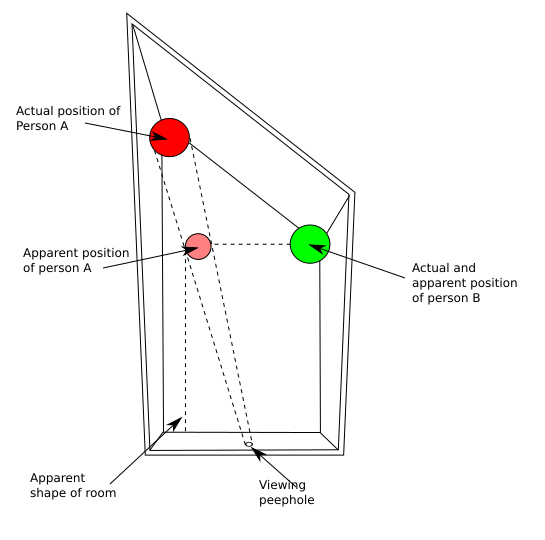
A special type of perspective illusion that employs simulated (adjusted real-space structure) and synthetic perspective (combination of visual [retinal perspective] and natural/environmental perspective) in which a room is employed with a distorted shape so as to be magnified in scale towards one corner. People or spatial objects that move, or are moved across, the room appear to grow or shrink in apparent size.
The concept and operation of an Ames room illusion relates to: natural perspective, environmental perspective, visual perspective, forced / decelerated / diminished perspective, simulated and synthetic, combined and double perspective.
An Ames room involves the following categories/forms of perspective…
- Simulated / Forced Perspective aka ‘false’ or ‘trick’ perspective (views of the built world): illusion by construction of a false reality (distorted/transposed scene geometry)
- Synthetic Perspective: a combination of natural perspective (combined visual [retinal] and environmental perspective) – and a form of artificial perspective (simulated / forced perspective).
- Combined Perspective: Multi-scene type: an image/view that combines natural and artificial scenes. Any perspective image (or system) formed of a conjoined or synthetically unified spatial scene, being a spatial scene that is composite (i.e. is synthetic or a combination of the natural and artificial perspective types) being optically or falsely unified (from a narrow range of viewpoints) and thus only apparently consisting of a single-scale space. Requires use of forced/accelerated/decelerated perspective methods and similar illusive techniques, to create the illusion of a single-scale space.
- Double Perspective: A type of combined perspective illusion in which two separate perspective spaces are combined into an apparent direct or simulated real-space view that exhibits illusive properties, and this space is created by having a type of forced perspective in which two falsely receding metric grids are conjoined visually enabling either: A) an apparently varying scale space similar to an Ames room, and B) the ability to hide/render-invisible objects or people behind apparently falsely positioned, or falsely scaled, objects. Double perspective is a combined perspective that can produce hidden or invisible regions of space for objects to hide within or be rendered invisible, and/or regions of multi-scale space similar to the Ames room illusion.
- Forced / Decelerated Perspective: The techniques of forced perspective manipulates the way we see and process our sight in order to trick us. For example, seeing depth where none existed, or placing real objects in juxtaposition with painted objects, etc. Decelerated perspective is a type of simulated and synthetic perspective (real-space structure) that employs the technique of forced perspective to decrease apparent perspective recession, or decrease the angle of vanishing lines directed towards vanishing points, and thus to decrease the apparent depth of the optical scene (or depth within partial regions of the scene).
 Perspective Research Centre
You must be logged in to post a comment.