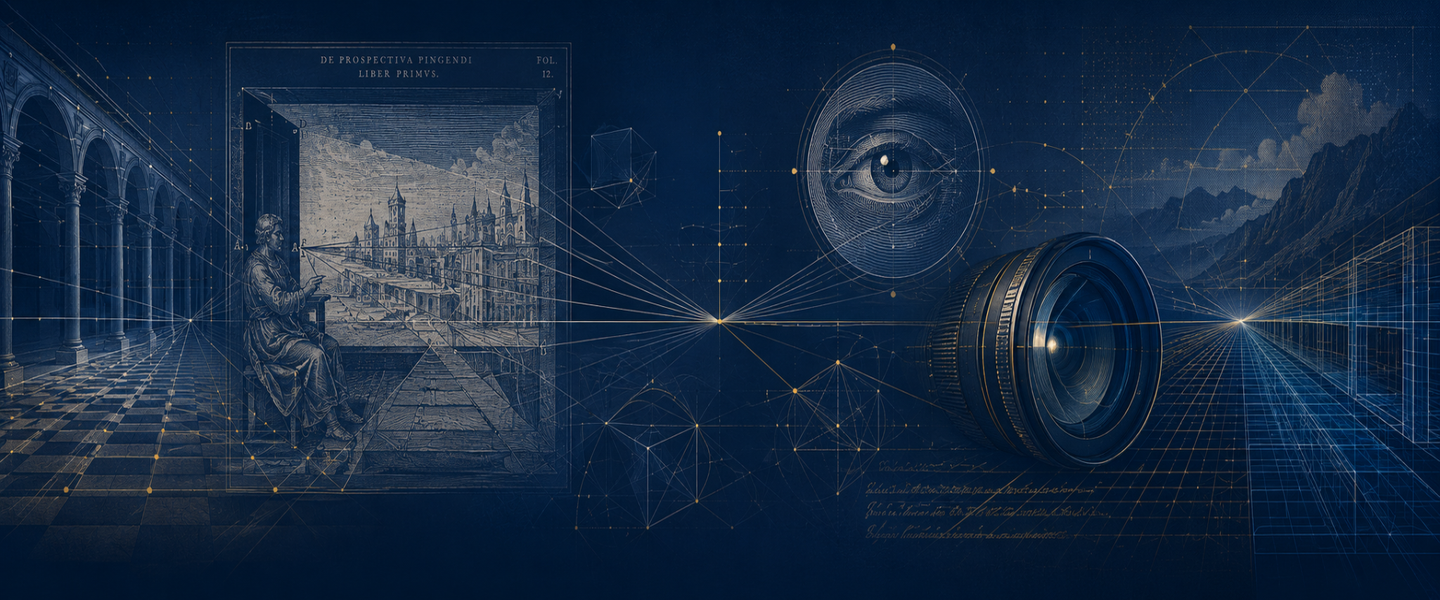

During the second half of the 20th century, photographic, cinematic, and television perspectives emerged, heralding many new subtypes, including moving perspective shots such as zoom/pan, dolly, tracking, and helicopter shots, as well as photomontage.
More recently, perhaps the most innovative developments have occurred in Virtual Reality and Artificial Intelligence, where a blending/merging of the real with the digital has taken place. Many times today, it has become difficult to distinguish between natural or optical images and digital or virtual images. In any case, such digital multi or metaverse trend(s) are set to continue and/or evolve.
Perspective and Progress
Perspective directs human attention ever forwards/outwards/upwards, providing new vistas on all spatial scales. Introduced is a systematic approach to three-dimensional spaces and objects contained therein. Perspective leads to mastery of the spatial topics, foreshadowing unprecedented innovations in art, science and technology.
Renaissance or linear perspective introduced an objective method for recording or copying the optical world at different levels of abstraction in photographs, cinema, engineering drawings, computer images, maps, etc. Yet newer types of perspective are recognised not so much by method as results.
Accordingly, we have three basic methods of optical perspective view <IMAGING CLASS>. First, looking-in/looking-at perspective uses an eye/camera/ representation to explore unidirectional, relatively narrow-field perspective images of a spatial object/area. Secondly, looking-out/around perspective uses an eye/camera/representation to explore wide- or multi-angle perspective images.
Finally, looking-through perspective allows seeing ‘through’ spatial scenes and/or perspective windows, or seeing ’inside’ spatial objects; using transparent perspective methods and/or projection displays (ref. optical/ digital methods).
Key Trends
A key trend is in digital modelling of perspective views/images. Overall, we see a blending of optical perspective methods/systems with real-time computing, remote sensing, Internet of Things, Virtual Reality, Artificial Intelligence, etc.
Ergo, a new age of super-informative, all-encompassing, real/simulated, and integrated perspective views/images is gathering pace. We humans potentially miss an infinity of sights, related to an object’s/scene’s structure/composition, because Forms are too small/large, too far, too dim, too fast, or hidden within opaque material(s); and we’re unaware of radiations beyond visible.
Today, through precise modern cameras attached to microscopes, telescopes, satellites, drones, strobe lights, radiation detectors, mobile devices, and computers, our conception of the world is undergoing a remarkable transformation. Modern perspective methods/systems/instruments allow us to move far beyond the limitations of natural vision. On all scales from the submicroscopic to the cosmic, they expand our vision, revealing vanishingly faint images, invisible radiation, events imperceptibly swift or slow, remote realms of space, and landscapes/oceans which we cannot capture unaided.
Perspective enables humans to better perceive, measure, model, and create views of spatial reality. In sum, perspective provides almost inconceivably powerful portals to a host of marvellous and enlightening visual worlds!