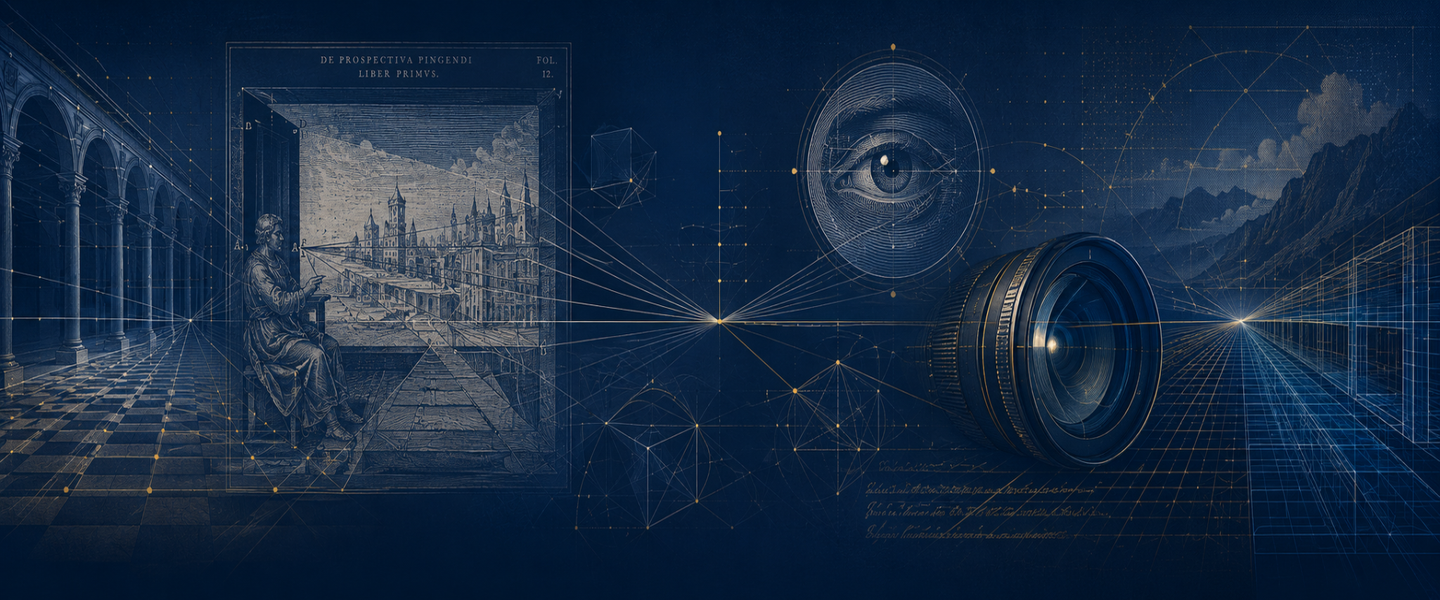

Anamorphosis is an optical illusion where an image appears distorted from a standard viewpoint but normal from a specific angle or in a mirror (mirror anamorphosis). Anamorphosis also refers to a violent distortion in perspective, from too near a point of view, and from injudicious altitude or situation of the object, but it is perfectly true according to the laws of perspective.
Anamorphic Perspective
Anamorphic perspective is a form of distorted projection that requires viewers to occupy a specific vantage point or use special devices (such as mirrors) to see a recognisable 3-D image from a 2-D surface. Derived from the Greek anamorphoûn (“to transform”), it acts as an optical illusion that hides or distorts images, often used in art, street, and film to create impossible, perspective-defying visuals.
It is a type of technical perspective in which an image is distorted (magnified/minified) in scale in one of its cardinal directions (X, Y), leading to an anamorphic image shape.
Anamorphosis can be used to create an anamorphic perspective illusion painted onto the wall of a room/corridor, etc, whereby (for example) the (ostensibly distorted) image of a spatially flat ghost appears to change from 2-D to 3-D, and ’pop’ or extend outwards into space or 3-D when viewed from the correct viewpoint, or from a particular viewing angle. This ia a type of visual perspective illusion that is partly psychological and partly optical/graphical in origin.
Cinematic Anamorphosis
The anamorphic process, which uses anamorphic or ‘Scope Aspect’ lenses to optically squeeze the (horizontal aspect) image onto an ordinary-sized film gauge frame or format (normally 36mm by 24 mm), and thus to optically capture or photograph twice the horizontal area (horizontal field of view) relative to the vertical as standard “spherical” or ‘Flat Aspect’ lenses.
The horzontally squashed or ‘scoped’ image is then unsquashed using a special reversing lens in the cinematic projector, or else via a digital process applied to the attended digital file.
Anamorphic Suspended Sculptures
Anamorphic suspended sculptures are 3-D, often abstract installations designed to reveal a coherent, recognisable image only when viewed from one specific station point. They are a form of installation art that uses distorted, often fragmented, three-dimensional forms hung in physical space (from strings/wires) to create an image visible only from a single viewpoint.
This art form relies on perspective anamorphosis, requiring the viewer to move to a predetermined vantage point to see the intended, coherent image, whereas from any other angle, the sculpture appears to be a random arrangement of objects or abstract shapes.
Artists and Works
- Michael Murphy: Murphy creates sculptures using hundreds of elements (like wooden balls) suspended from the ceiling. A famous example is Perceptual Shift (2015), which appears to be a jumble of 1,252 painted wooden balls but, from a specific spot, reveals the image of an eye.
- Jonty Hurwitz: Creates anamorphic sculptures that often rely on a polished, mirrored cylinder to correct the distortion. His work, such as The Kiss or The Thinker, often appears as a nonsensical, stretched, or distorted object to the naked eye, but appears in perfect proportion when viewed through the reflection of a cylindrical mirror.
- Matthieu Robert-Ortis: A French artist who creates wire sculptures that, when viewed from different angles, transform into entirely different subjects, such as The Revolution of Giraffes, which shifts between the figures of two giraffes and one elephant.
- Bernard Pras: Known for using discarded objects and “junk” to create anamorphic installations, which, from a specific viewpoint, form a coherent, recognisable image.
Techniques and Outcomes
- Forced Perspective: viewer occupies a specific, “sweet spot” in space to “unlock” the hidden image.
- Disguised Meaning: Historically, this technique was used to hide politically or religiously sensitive images, allowing them to be viewed only by those who knew where to stand