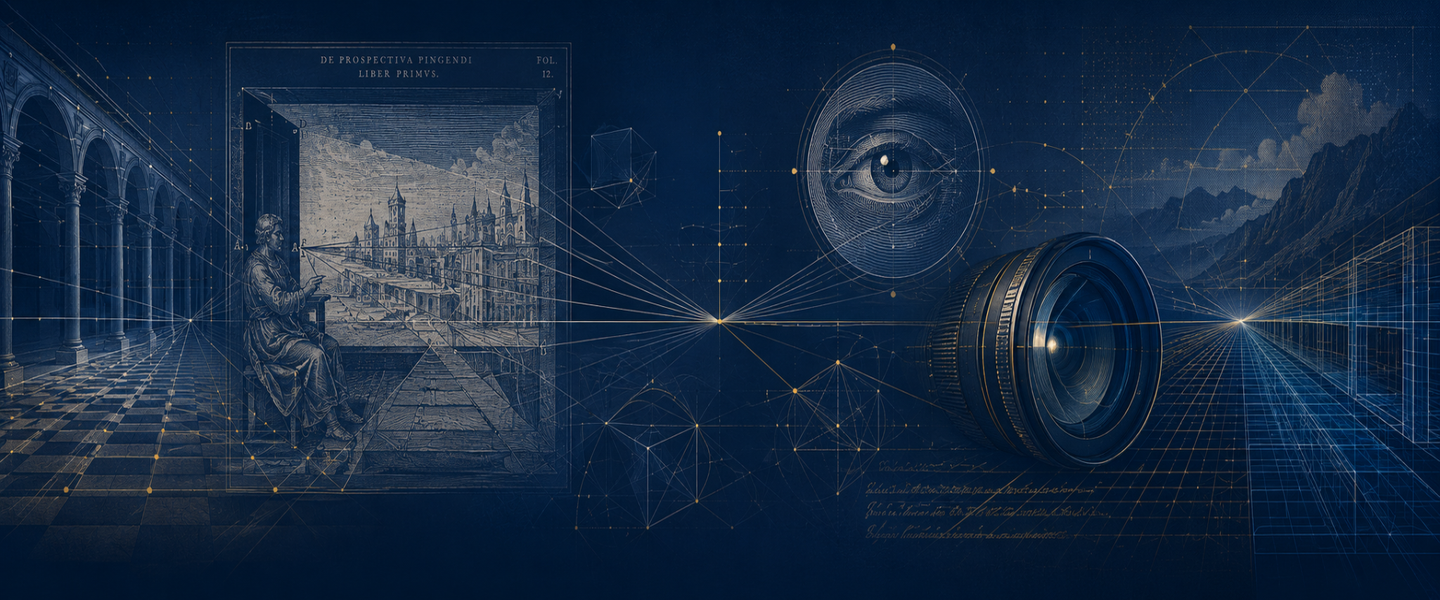

A long-standing question within art, science, and philosophy; asks if perspective is merely a human convention, or else the discovery of a natural phenomenon. It may actually be both—and the answer given may depend upon the Category/Form of Perspective considered. Let us approach the riddle by taking each type of perspective in turn.
Is Perspective a Convention or a Discovery?
It is helpful to recognise that there are basically two kinds of what we have termed Natural Perspective. To begin, Environmental Perspective is a Category of Visual, Optical, and Technical Perspective consisting of naturally occurring optical phenomena, such as the projection of shapes and shadows, reflection and optical line-of-sight problems, plus astronomical seasons, eclipses, etc. Such rudimentary visual projections/measurements are naturally occurring phenomena, and hence are discovered.
Next, we have Visual Perspective (second type), which is concerned with direct looking at spatial reality using human or animal vision. However, there are many varieties of animal vision, based on two basic types: composite and non-composite Eyes. Science explains that Visual Perspective emanating from animal vision results from a long process of natural evolution; hence all types/forms of animal vision may be considered ‘inventions’ of life itself (in one sense). But each ‘eye’ represents discovery of particular working optical principle(s) to achieve specific results. Accordingly, Visual Perspective (2nd type) is both a convention and discovery.
But what about other forms such as Graphical, Mathematical, or Instrument Perspective—once again—are these convention or discovery? To begin, the simple graphical technique of Linear Perspective would seem to be equal parts convention and discovery. Next we consider Perspective Instruments such as a simple bi-convex lens, operating as a type of light-ray ‘sorter’. We can classify that as a standard physical process, or an extension of a pin-hole camera, and therefore is more of a discovery than a convention. By contrast, complex inventions, with multiple inventive ‘steps’, such as the sector, compass, sundial, astrolabe, microscope, telescope, photographic camera/projector, etc., are closer to convention.
Considering a New Media Perspective system such as Virtual Reality (VR)—well that rests upon many thousands, if not millions, of ‘bundled’ inventions in fields such as optics, electronics, computing, etc. Ergo, we can say that Virtual Reality (operationally) is more of a convention than a discovery.
In conclusion, we have by no means decided if perspective is a convention or a discovery, but rather demonstrated that the issue is complex and that the answer depends on the Perspective Type/Form considered.
The Eye and Evolutionary Processes
Another related long-standing debate in relation to eyes concerns how a highly complex organ, such as the human eye, could come into being. This debate pits proponents of science (evolution) against those of religion (divine intervention).
We shall assume that eyes are the result of evolutionary processes over aeons of time. There are wide varieties of animal vision, based on two basic types: composite (compound) and non-composite (non-compound) eyes. Science explains that visual perspective emanating from animal vision results from a long process of natural evolution; hence, all types/forms of animal vision may be considered ‘inventions’ of life itself (in one sense). Whereby each ‘eye’ design represents the discovery of multiple inter-operating optical principles to achieve specific results.
However different eyes use different designs and employ a wide variety of imaging methods. Compound eyes, for example, are a type of visual organ found in many arthropods, including insects and crustaceans, that are made up of thousands of tiny units called ommatidia. Each ommatidium contains a separate lens, cornea, and photoreceptor cells that can distinguish colour and brightness. Compared with single-aperture eyes, compound eyes have lower image resolution; however, they offer a very wide field of view and the ability to detect fast movement and, in some cases, polarisation.
Accordingly, due to the diversity in design (and imaging results), eyesight or visual perspective (2nd type) can be considered to be both a convention and an evolutionary process or discovery.