
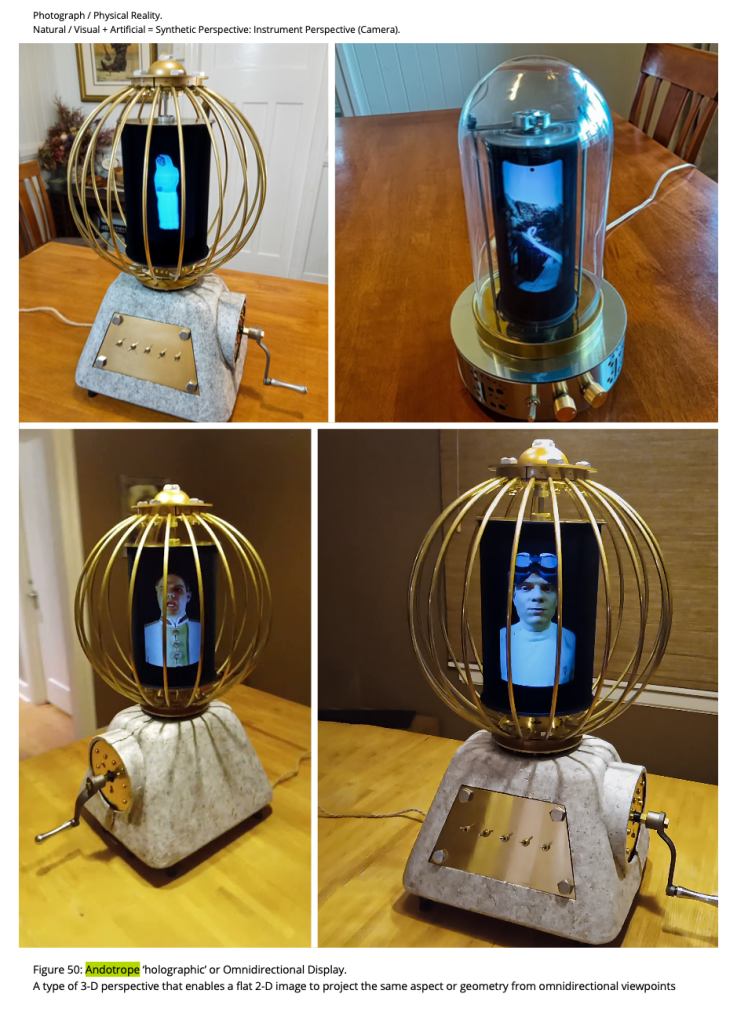
An Andotrope is a new type of 3-D perspective that enables a flat 2-D image to project the same aspect or perspective geometry from omnidirectional viewpoints, that is, the 2-D image looks identical from a full 360 degrees (it produces 360-degree identical views of a flat or 2-D object).
This form of perspective image is also named 3-D/2-D perspective, which produces 360-degree identical views of a flat or 2-D object or scene. The displayed 2-D image can be a moving image; as in Figure 1, which uses an iPhone with video as the source/projected image.
Omnidirectional Display
An andotrop is a type of omnidirectional representation of 2-D scene/object (monocular) or 3-D scene/object (binocular); it is an omnidirectional display.
An omnidirectional display is a new type of swept-plane display 3-D perspective that enables a flat 2-D image to project the same aspect or perspective geometry from omnidirectional viewpoints or multiple station points, that is the 2-D image looks identical in perspective projectional terms from a full 360 degree point-of-view (the image does not display viewpoint dependant geometry outline changes or aspect projection changes). Another way of describing 3-D/2-D perspective is that it produces 360-degree Identical views of a flat or 2-D object or scene.
Principle of Operation
An andotrope is a type of modern zoetrope or omni-directional display invented by Mike Andos, whereby he mounts two IPhone displays back to back each showing an identical video that is synchronised in time (playing the same video sections at identical times).
Next, he mounts the phones vertically and also mounts an obscuring tube over both phones, but the tube has two vertical slits (each operating as an optical limiter) and each one mounted directly in-front of the separate phone screens.
Next, we simply spin the device, and the whole cylinder rotates at high speed (up to 1200 RPM, which gives an effective 40 frames per second moving image). Both tablets synchronise their output, effectively doubling the frame-rate by displaying two images per rotation. As the mechanism rotates, your view through the red slits sweeps across the displays, which ensures everyone in all directions ends up with a view of the full screen.
The result is a flat or 2-D moving image that can be seen in the same aspect or appears from an identical fixed viewing direction, but as seen from omnidirectional viewpoints or multiple station points, that is the 2-D image looks identical in perspective projectional terms from a full 360 degree point-of-view.
This device uses a principle similar to the persistence of vision effect whereby you perceive a single stable but moving image. You can say that this is a type of 3-D display that presents an unchanged 2-D image perspective projection from all directions. Another way of describing such a 3-D/2-D perspective is that it produces 360-degree Identical views of a flat or 2-D object or scene. An Andotrope provides an omnidirectional, bill-boarding holographic video to multiple simultaneous viewers in all directions.
 Perspective Research Centre
You must be logged in to post a comment.