
An astrolabe is an astronomical instrument dating to ancient times, serving as a star chart and physical model of visible heavenly bodies. Its various functions also make it a sophisticated inclinometer and analogue computing device for working out several kinds of problems in astronomy.
In a simple form, the astrolabe is a metal disc with a pattern of wires, cutouts, and perforations that enables the user to calculate astronomical positions precisely. It is able to measure the altitude above the horizon of a celestial body, day or night; it can be used to identify stars or planets, to determine local latitude given local time (and vice versa), to survey, or to triangulate.
The astrolabe was used in classical antiquity, the Islamic Golden Age, the Middle Ages, and the Renaissance for all these purposes.


Astrolabe Components and Operation
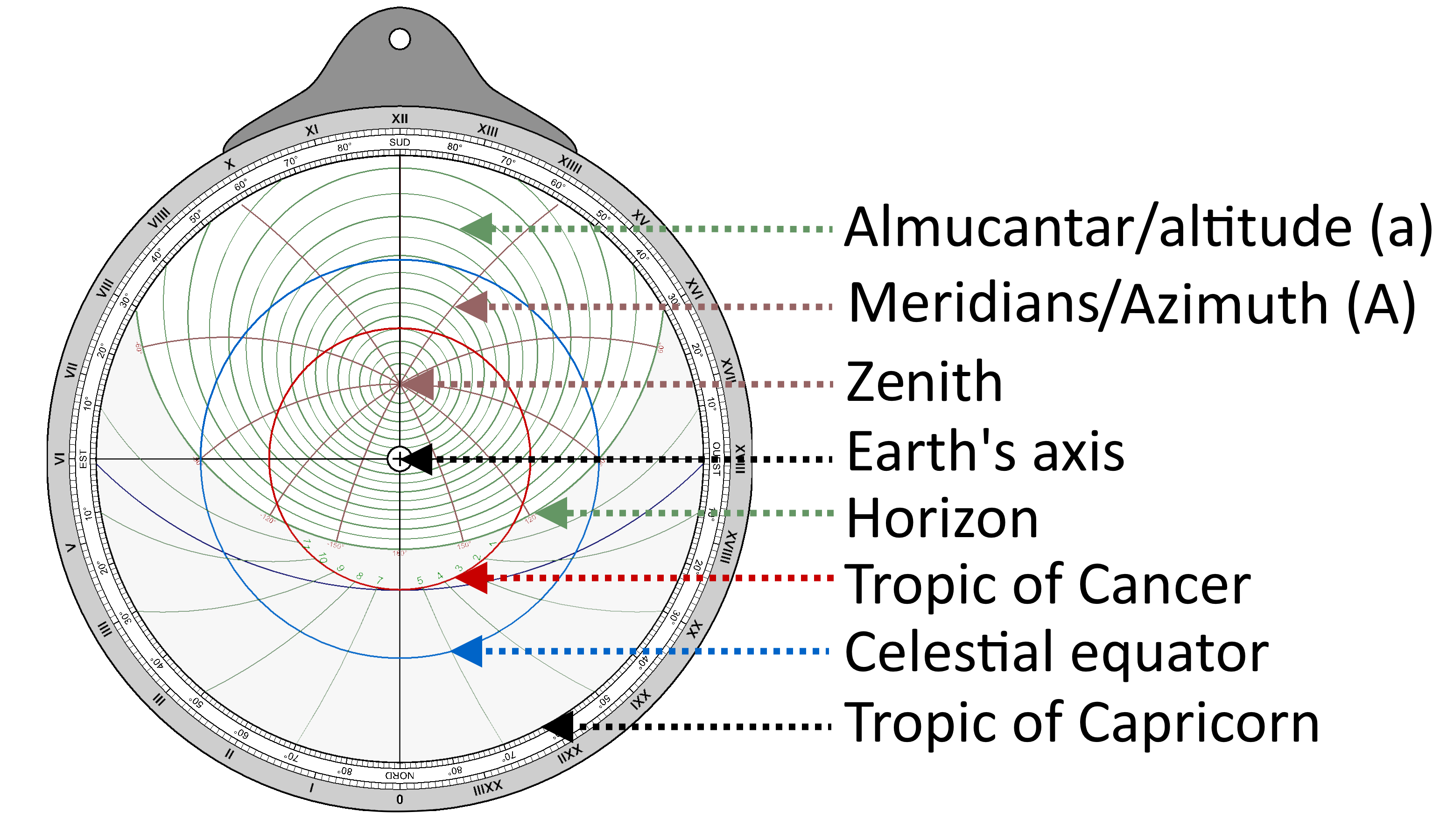
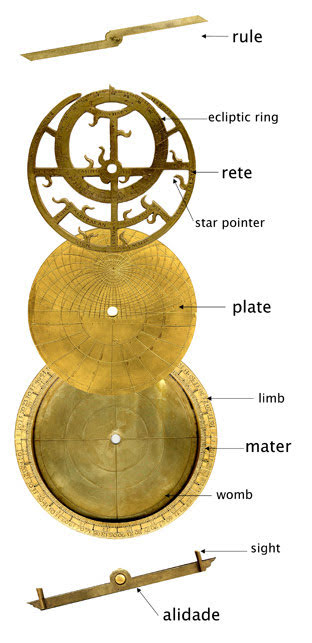
An astrolabe consists of a flat disk, called the mater (mother), which is deep enough to hold one or more flat plates called tympans, or climates. A tympan is constructed for a specific lattitude and is engraved with a stereographic projection of circles denoting observer azimouth and altitude and representing the portion of the celestial sphere above the local horizon. The rim of the mater is typically graduated into hours of time, degrees of arc, or both.
Above the mater and tympan, the rete, a framework bearing a projection of the ecliptic plane and several pointers indicating the positions of the brightest stars, is free to rotate. The names of certain indicated stars are engraved on the pointers in Arabic or Latin. The rete, representing the sky, functions as a star chart. When it is rotated, the stars and the ecliptic move over the projection of the coordinates on the tympan (representing rotation of the heavens). One complete rotation corresponds to the passage of a day.
The astrolabe, is a predecessor of the modern planisphere. A planisphere is a star chart or analog computing instrument in the form of two adjustable disks that rotate on a common pivot. It can be adjusted to display the star positions for any time and date. It is used to assist in learning how to recognize stars and constellations.
 Perspective Research Centre
You must be logged in to post a comment.