
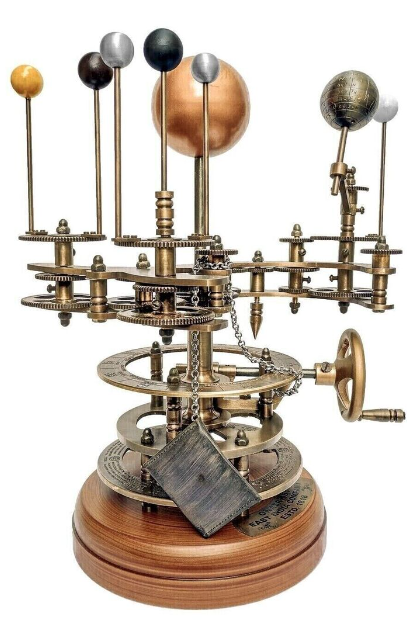
An orrery is a mechanical model of the Solar System that displays the relative positions and motions of the planets and (larger) moons. It sometimes represents the relative sizes of these bodies; however, accurate scaling is often not possible due to the actual large ratios involved, so a scaled-down version is employed. The Greeks had working planetaria or planetariums; which is a theatre built for producing educational shows about astronomy and the night sky; however, the first modern version was produced by John Rowley in 1712.
Earlier examples of Orrery-like devices are multiple. In the book Xin Yi Xiang Fa Yao, published in 1092 by Chinese scientist Su Song, a star map is given based on an equidistant cylindrical projection.
The Antikythera mechanism, considered one of the first orreries, was discovered in 1901 in a wreck off the Greek island of Antikythera in the Mediterranean Sea. This is regarded as the first example of an analogue computer, and displays the diurnal motions of the Sun, Moon, plus the five planets known to the ancient Greeks. It has been dated between 205 and 87 BC. It employed geocentric model, and was used as a calculator for astronomical positions.
 Perspective Research Centre
You must be logged in to post a comment.