
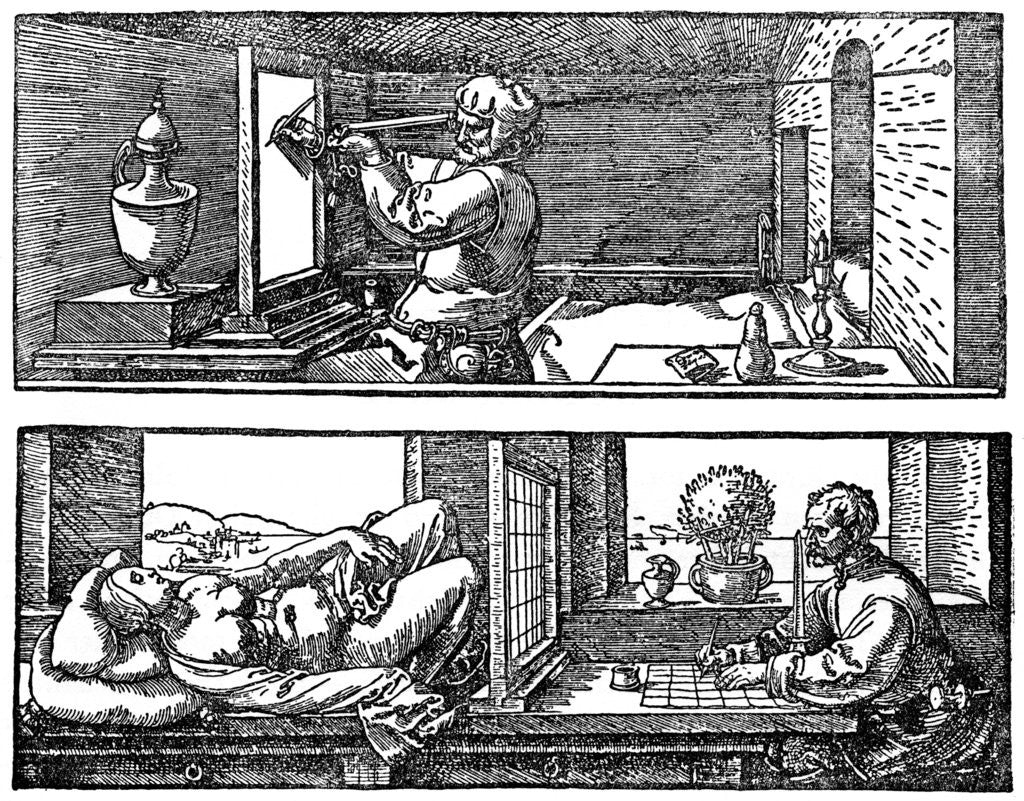
A perspective window or draftsman’s net is a device used in the procedure of making a manual drawing according to (for example) the rules of linear perspective. Whereby a transparent perspective window or picture plane is placed in front of a 3-D object/scene, whereupon a viewer sitting on the other side of the screen employs a notionally stationary eye to copy a visible outline of the observed scene as it appears on said perspective window (i.e., fixed spatial location eye but looking along multiple object-tracing line(s)-of-sight).
Hence, the so-called perspective ‘window’ principle comprises a specific arrangement of—object, window, and stationary-eye (fixed view-point and fixed viewing-direction), working together as a visual mechanism to produce this type of Linear Perspective image.
The perspectival window or veil, was by far the most popular of perspectival instruments. Alberti (1434) claimed that it was indispensable for perspectival construction. Piero della Francesca (c. 1480) described it, Leonardo drew it (c. 1490), Dürer (1525) published it, and via Barbaro (1568), it subsequently became known as Dürer’s window in Italy. Dürer’s student, Rodler (1531) used the window for landscapes, an idea which found both military and practical applications.
The window became much more than a simple mechanical aid. According to Danti (1583), Tommaso Laureti produced a model window specifically to demonstrate the principles of perspective, an idea taken up by the French Academy of Sciences.
As early as the 1490’s, Leonardo da Vinci devised games which used the window principles to improve one’s judgment of distance. Later authors such as Accolti (1625) and Bosse (1648) used the window to reveal reciprocal relationships of size and distance and as a tool for imposing a geometrical framework on nature. This made possible the equations between optics, geometry and perspective, which were taken for granted after the 19th century and have continued to the present.
Imaginary Picture Plane
Another name for the perspective window is the imaginary picture plane, being a window that intersects the visual pyramid, and upon which you trace the outline of an object beyond.
In the 15th Century, perspective came to mean seeing through a transparent glass-plane on which the spatial scene is traced from a single fixed eye-point (the window is used to fix the location and angle-of-view of the artist/observer). A geometrical example is the procedure of making a manual drawing according to the ‘legitimate construction’ rules of linear perspective.
Perspective, says Leonardo, is nothing else than seeing a place, behind a plane-of-glass, quite transparent, on the surface of which the objects which lie behind the glass are to be drawn. They can be traced in pyramids-of-vision to the point in the Eye and these pyramids are intersected by the glass-pane. The pyramids are composed of the visual-rays, which link the visible surfaces of objects to the Eye.
Perspective Drawing Frame
A constructed example of perspective window is a perspective drawing frame, used by artists such as Leonardo, Viator, and Durer; which consists of a wooden frame operating as a doppelgänger to the picture plane, and upon which the artists could accurately measure (visually) perspective images lying beyond the frame.
Often the frame would be cross-indexed with a checkerboard pattern of strings, or have ruled markings on the edges, and sometimes another upright stick would fix the artist’s eye position, field-of-view, and direction of looking.
Also, the frame could be used with mechanical methods such as strings drawn from eye point to object points, etc. In this manner, the perspective window becomes a recording medium that contains a perspective image; in the form of an artist’s canvas, film, computer screen or some other medium that stores the visual information contained therein.
It is essential to realise that the perspective window, a fixed eye-point, and object location are the most basic elements of a perspective view/image, fundamental to all categories/forms of perspective, including visual, mathematical, graphical, instrument perspectives, etc.
 Perspective Research Centre
You must be logged in to post a comment.