
A brief review of our research and development activity.
Global-Opt
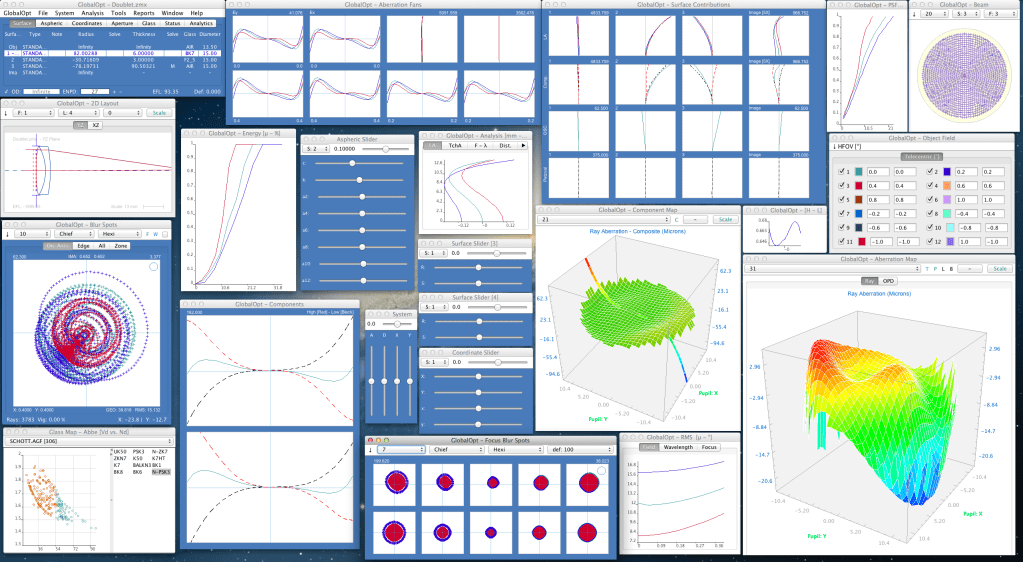
GlobalOpt [1990-2015] is optical modelling software for the analytical design of optics, including lenses and cameras. GlobalOpt has breakthrough features for solution discovery. It compliments and extends existing tools, providing comprehensive aberration analysis and a powerful solution-finding capability.
GlobalOpt lets you explore design “space” in an exceptionally wide-ranging and fine-grained manner, and with it you can locate solutions that merit function and automatic methods miss altogether. GlobalOpt employs a LIVE plus VISUAL design methodology; performed by making real-time parameter adjustments; whilst watching corresponding changes to aberrations using super-informative graphics.
Of particular note are the Aberration Contribution Plots and Maps; which magnify design knowledge. Plus when combined with easy-to-use sliders and an advanced user-interface, provided is a whole new way to interact with optics.
Spectasia
Spectasia [2003-2009] is a design for a new class of 3-D Lookable User Interface which enhances the information visualization and retrieval capabilities of computer users in a wide range of circumstances.
Spectasia was developed as a full-blown application for windows and Mac systems (approx, 40,000 lines of Java code). Spectasia was featured in major publications worldwide and had over 80,000 downloads/users in 2009. The Spectasia project is now ‘mothballed’, but still has a detailed Wikipedia page.
Spectasia amplifies the visual search, navigation, and also selection capabilities of users when interacting with digital content. It employs curvilinear perspective, which is similar to an extremely wide-field view of a scene as projected by a fish-eye camera lens. We chose this form of perspective to provide, an exaggerated impression of depth to the user, plus an expanded representational “space”.
Here a large number of objects can be rapidly scanned, and the impression of item location, and 3D or depth, is a very strong one. A key advantage is that users can focus their attention on the precise screen location of desired items with greater accuracy, immediacy, and within a predictable time scale.
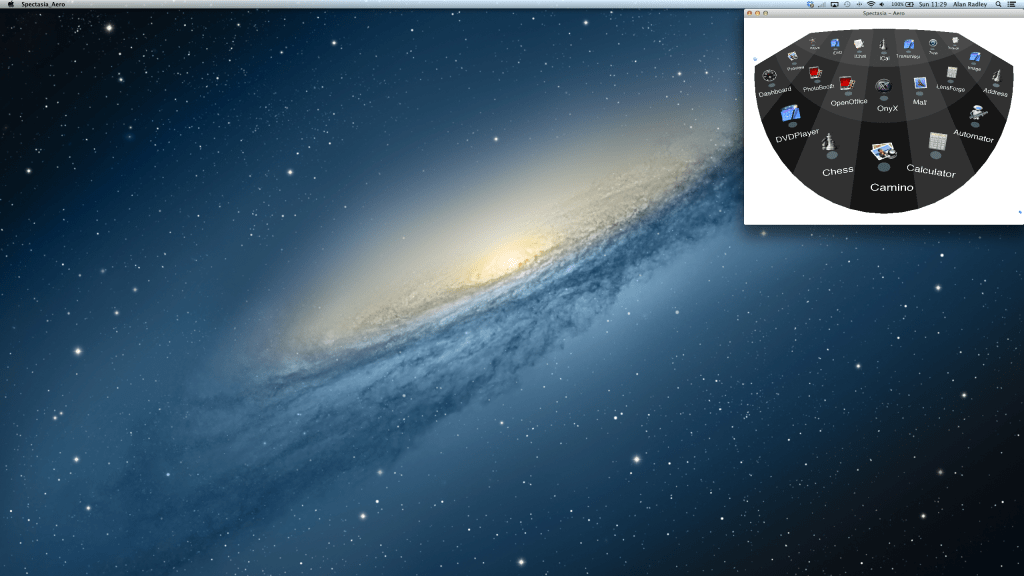
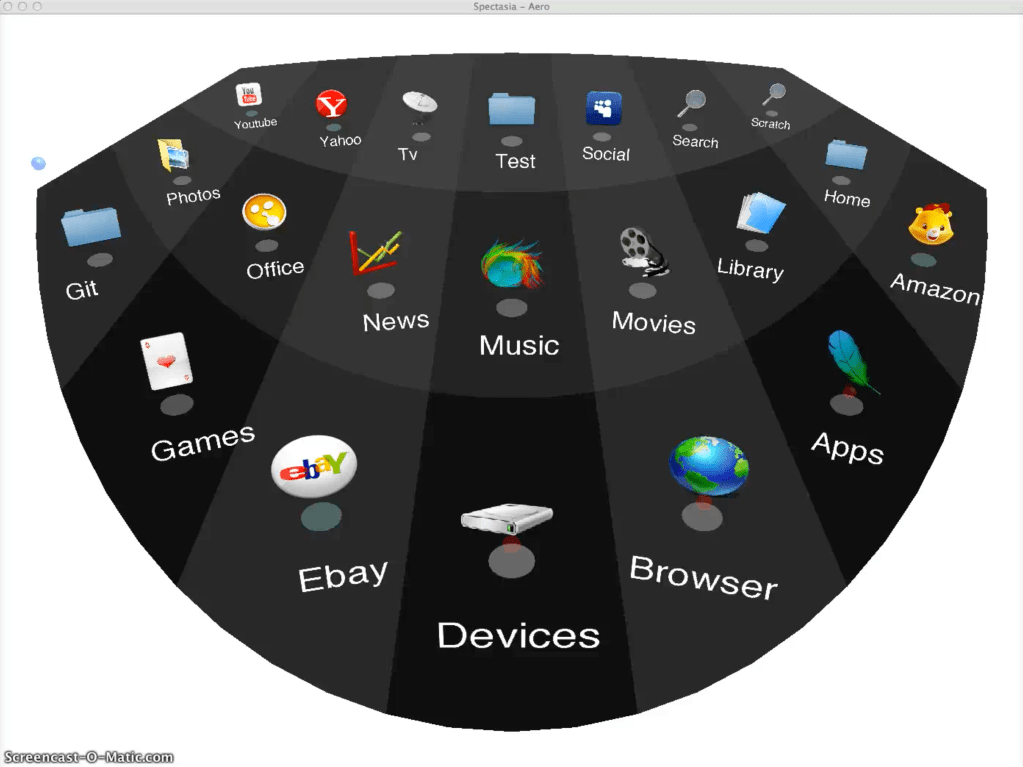
Spectasia is applicable in those situations in which a smooth blending of focus (i.e., projected visual detail) plus context (positional, ordinal and structural relations) is to be maintained during simulated optical zooming and panning operations. The visual objects can be animated under user control to either bring new regions of the hierarchy into view or to bring “distant” objects closer to the viewpoint.
Simple-to-use on-screen navigation cursors, scroll position indicator displays and level indicators allow the user to navigate, and to efficiently browse, all types of content. Spectasia is applicable in a wide variety of information display scenarios, including hand-held devices, PCs, information kiosks, and shopping terminals. The display area can be finely scaled to achieve efficient utilisation of the span of display elements (or pixels) or to affect rapid field-of-view customisation.
Spectasia is serviceable wherever digital content is to be presented as an array of item choices or where product/item categories are to be browsed and/or navigated. It is applicable to different kinds of display systems, including the 2-D or 3-D stereographic class.
Hologram Mirror
A notable invention is the Hologram Mirror, and when we sent the specification to the UK Patent Office—the examiner called us up on the telephone saying:
“Am I speaking to the inventor of the Hologram Mirror—because your invention is so incredible.. and has created quite a commotion within the Optics Department of the UK Patent Office. It took us quite some time to believe that the incredible results achieved by this invention are even possible!”
UK Patent Examiner, 2009.
Subsequently, we have been granted a Patent for our ”Hologram Mirror”, a new type of mirror for use in cosmetic and medical applications.
Here are links to the > Patent Application and > Specification.
How does the “Hologram Mirror” differ from ordinary mirrors? Well, a plane mirror forms a rather cluttered image of the observer (perceptually) that must compete with images of all those objects that happen to be within the field of view. Additionally, plane mirror images are not truly life-like; they are hidden and somewhat inaccessible behind a glass screen. Our method produces a three-dimensional (3-D) image that floats in space in front of the mirror surface!
When used by a person to look at his reflection, the “Hologram Mirror” produces an image of the person’s face, but without the clutter of background images that are normally seen. The image is at a one-to-one scale or life-size, and you are thus able to see your face exactly at the same scale and in three dimensions as when other people look at you!
Is this not an incredible result for a set of ingeniously arranged—but otherwise wholly ordinary—reflecting mirrors?

A short explanation is helpful, whereby we refer to the drawing above.
We can see that the mirrors labelled 2 and 3 form an upside-down image of a subject (1) at 4, whereupon a (partially transparent) mirror labelled as 5 re-images this intermediate image into an upright, life-sized reflection of a person (7) that is seen “floating” in space at a short distance in front of the person (1).


 Perspective Research Centre
You must be logged in to post a comment.