
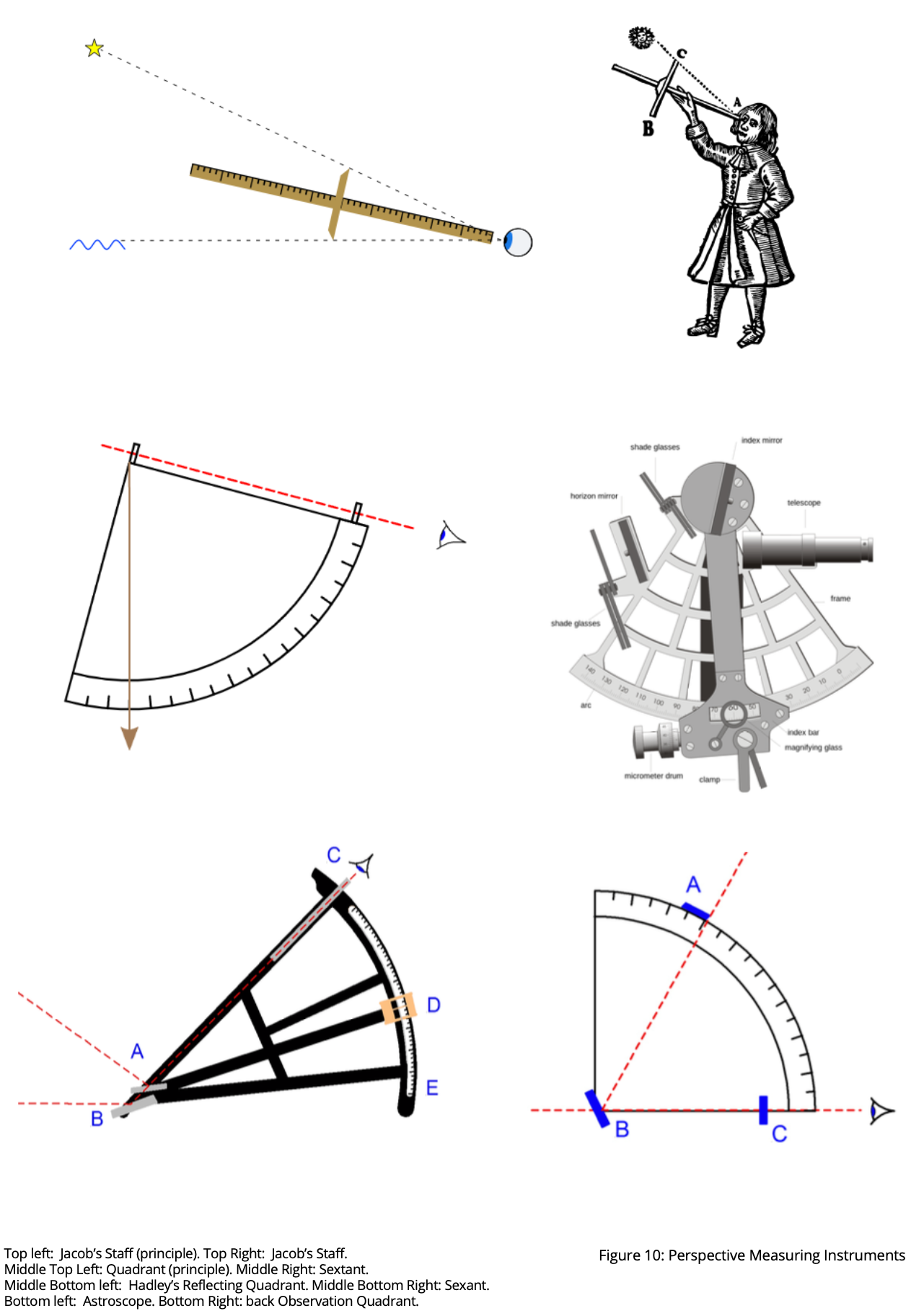
A sextant is a doubly reflecting navigation instrument that measures the angular distance between two visible objects. The primary use of a sextant is to measure the angle between an astronomical object and the horizon for celestial navigation.
The operation is quite simple and similar to an octant. The sextant makes use of two mirrors, and the sextant principle of double reflection. With the sextant, one of the mirrors is half-silvered, allowing some light to pass through. Whilst navigating, you look at the horizon through this mirror. By 1780, the octant and sextant had displaced all previous navigational instruments. Sextants were later developed with wider arcs for calculating longitude from lunar observations, and they replaced octants by the second half of the 18th century.
Octant
An octant is a reflecting optical instrument used for celestial navigation. The name derives from the Latin octans meaning eighth part of a circle, because the instrument’s arc is one-eighth of a circle. The name octant or reflecting quadrant derives from the instrument using mirrors to reflect the path of light to the observer and, in doing so, doubles the angle measured, enabling the instrument to use just one-eighth of a turn to measure a quarter-turn or quadrant. Octants were first used to calculate latitude.
The octant has several advantages over previous instruments. The sight is easy to align because the horizon and the star appear to move together as the ship pitched and rolled, hence observation errors were less frequent. By using shades over the light paths, one could observe the sun directly, while moving the shades out of the light path allowed the navigator to observe faint stars. This made the instrument readily usable during both night and day.
 Perspective Research Centre
You must be logged in to post a comment.