
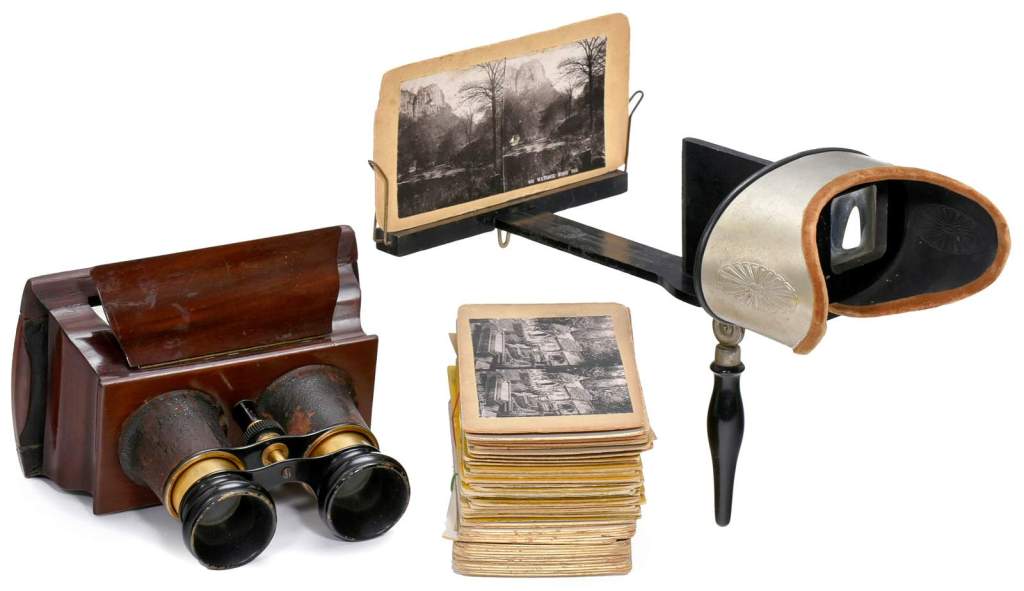
A stereoscope is a device for viewing a stereoscopic pair of separate images, depicting left-eye and right-eye views of the same scene, as a single three-dimensional image; whereby the viewer can use his binocular vision to see 3-D images that seem to pop-outwards from, or recesses into, the depth direction.
The earliest stereoscopes, designed to produce stereoscopic images/views, “both with reflecting mirrors and with refracting prisms”, were invented by Sir Charles Wheatstone and constructed for him by optician R. Murray in 1832.
Stereoscopic Principle
The stereoscope is an instrument in which two photographs of the same object, taken from slightly different angles, are simultaneously presented, one to each eye. This recreates how natural vision works, whereby each eye is seeing the object from a slightly different angle, since they are separated by several inches, which is what gives humans natural depth perception. The process is also named stereoscopic depth, or binocular depth perception, using the so-called binocular depth cue(s).
Often, a stereoscope provides each eye with a lens that makes the image seen through it appear larger and more distant and usually also shifts its apparent horizontal position so that for a person with normal binocular depth perception, the edges of the two images seemingly fuse into one “stereo window”.
Most people can, with practice and effort, view stereoscopic photographic image pairs in 3-D without the aid of a stereoscope (or accompanying lenses).

 Perspective Research Centre
You must be logged in to post a comment.