
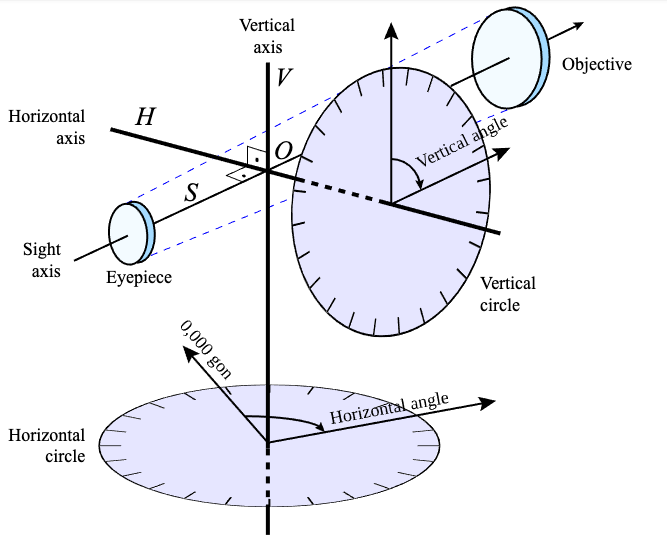
A theodolite is a precision optical tool used in surveying, mapping, and other fields. It is a surveying instrument that measures horizontal and vertical angles with high precision. It’s like a telescope with graduated horizontal and vertical circles attached, allowing for precise angle measurements.
Principles
- Phototheodolite: A combination camera and theodolite used in mapmaking.
- Telescope: A theodolite has a telescope with horizontal and vertical circles marked with graduations.
- Graduated Circles: Horizontal and vertical circles, often with fine graduations, enable precise angle readings.
- Tripod: Theodolites are typically mounted on a sturdy tripod to ensure stability during measurements.
- Leveling Mechanisms: Features like leveling screws and spirit levels help ensure the instrument is properly aligned for accurate measurements.
- Focus Knobs: These allow the user to adjust the focus of the telescope to achieve a clear image.
- Spirit Level: A spirit level helps to level the theodolite.
- Crosshairs: Crosshairs in the telescope help to align it with the target.
Applications
- Surveying: Theodolites are used to measure angles for triangulation in road building, tunnel alignment, and other civil engineering work.
- Mapping: Theodolites are a key instrument in mapping.
- Meteorology: Theodolites can be used to measure the position of objects in the atmosphere.
- Rocket launching: Theodolites can be used in rocket launching.
Variants
- Transit: A type of theodolite where the telescope can be reversed.
- Phototheodolite: A combination camera and theodolite used in map making.

 Perspective Research Centre
You must be logged in to post a comment.